SIGnetwork: March 2023


This week I found myself defending the need to collaborate. My little soapbox speech was more passionate than I expected, as I presented the concrete example of my early teaching days (thank you SUCCESs principles!). I was young and green, but even then I knew my kindergarten students would experience general education settings only if I had strong relationships with the other teachers. Building these relationships was not difficult or arduous work, in fact I enjoyed it, but I understood if I was not socially accepted, my students wouldn’t be either.
This week I have seen collaborative efforts pay off in so many ways. First and foremost, I learned a SIGnetwork State had surpassed its target for graduating native students with disabilities. This State has collaborated with many other SIGnetwork States and is always in the process of learning and evolving. On top of that good news, I received approval for an OSERS blog to be written by SIGnetwork States that will describe their work to improve outcomes for native students with disabilities. I was also invited to speak on a panel that special education had not previously been part of, which may be a result of my outreach and offers of support to the office. Finally, I proposed a concept I had been bouncing around for years and received support for the idea, -after my colleagues encouraged me to share it.
Like most people in DC, I am type A about my work. At times I’ve take the “do it alone” route in an effort to be efficient. If this week has been any indication; however, it is well worth it to follow the adage: “If you want to go fast, go alone. If you want to go far, go together.” In SIGNetwork we have the privilege and pleasure of learning from so many courageous, smart, dedicated folks from all over the country. Thank you for being generous with your time and talents, and thank you for embodying optimism in your perseverance. Judy Heumann would be proud. See the News section for an explanation…
Warmly,
Jennifer Coffey
News You Can Use


Standing up for Disability Rights: A Day of Reflection & Action | Facing History and Ourselves
One of the greats in disability advocacy, Judy Heumann, has died. Judy was the Assistant Secretary in the Office of Special Education and Rehabilitative Services (OSERS) during the Clinton Administration. Prior to that she was a rabble rouser (in the best sense of the term) and successfully fought to have the Americans with Disabilities Act passed.
We have used the 4H introductions for the last year, with one of the H’s standing for hero. Judy was one of my heroes, and I am certainly not alone in that feeling. She was the ultimate model of persistence and courage. I strive to be like her and now there’s a movement to get others to emulate her behavior.
On March 30, 2023, Facing History & Ourselves is hosting a special day of reflection and action in honor of Judy’s incredible life and work. You can choose from a menu of activities to honor Judy’s life by helping to live out her mission. Please let us know if you do and we can collect your story and experience.
Watch, Listen, Hear: SIGNetwork conference videos and podcasts now available! Didn’t get to see Kim St. Martin describe bi-directional MTSS? Well now you can. Just go to https://signetwork.org/spdg-virtual-national-meeting/ and enter the password SPDG
Attend: The OSEP Project Directors’ Conference is in person July 24th – 26th and attendance is required for all Project Directors. Please book your lodging today!
Prepare: The SPDG National Meeting will also be in-person in DC October 18th and 19th. Watch this space for more information




Upcoming SIGnetwork Webinars & Learning Communities


SPDG Directors’ Webinar: Coaching and Communication continues!

Coaching: Diana Mosha from Partnership for Los Angeles has supported regional, district, and building level coaching. She will share:
- Recruiting coaches;
- Administrator roles and responsibilities related to coaching;
- Systems/infrastructure that support coaches; and
- Evaluating coaching impact.
Communication: UNEXPECTED is the next SUCCESs principle we’ll dive into. Greg Wertenberger will share an unexpected piece of data that has driven action in Arkansas. Please bring something unexpected (idea, data, anecdote, etc.) that could drive engagement or action.
SPDG Success!




The Florida SPDG supports Check and Connect implementation. In schools at the initial to full implementation stages of Check and Connect, 85% of students with disabilities showed progress or met the target for attendance. This was 15% greater than the target set.
Additionally, the Florida SPDG supports the Strategic Instruction Model (SIM). In schools at the initial or full implementation stages of SIM, 90% of students who participated in the reading intervention showed progress or met the grade-level reading target. This was 20% greater than the target set.
Together, these data represent impacts for more than 1300 students.
Improving Professional Learning


Personnel Development Resources
IRIS Fundamental Skills Sheets


IRIS Fundamental Skill Sheets provide quick primers or reminders about discrete skills that are indispensable to any classroom educators’ toolbox. Each concise resource defines a skill, summarizes the evidence-base, provides steps and tips for implementation, and—best of all—contains brief demonstration videos with both examples and non-examples. There are currently seven skills featured in the collection:


Data-Informed


New Report: How Districts Use Federal Funds to Attract, Train, and Retain Educators
Ensuring students’ equitable access to talented educators remains a national priority. Congress established the Teacher and School Leader (TSL) Incentive competitive grant program in 2015 to support districts in improving their systems for hiring, supporting, and retaining educators, particularly in high-need schools. This report provides the first comprehensive review of activities grantee districts prioritized with their TSL funds and how well these activities aligned with key aspects of the program. The report is based on interviews conducted near the end of the initial 3-year grant period for the 24 districts in TSL’s first cohort awarded in 2017 and is part of a broader evaluation of TSL required by Congress. Key findings include:
- TSL districts prioritized strategies to improve their educator workforce over strategies to improve their data infrastructure, perhaps because districts felt they already had an adequate system to drive decisions.
- TSL districts most commonly prioritized performance-based compensation and personalized support, such as with bonuses or teacher leaders who coach teachers.
- Only some TSL districts indicated that their prioritized activities were central to improving educator diversity or increasing underserved students’ equitable access to effective educators, suggesting that grantees may not have emphasized these issues as much as the program expected.
Results from the 2020–21 National Teacher and Principal Survey


Redesigned from the Schools and Staffing Survey (SASS), the National Teacher and Principal Survey (NTPS) is a primary source of information about what is happening in K‑12 schools across the United States.
Family Engagement Done Well


State leadership to Strengthen Family Engagement Programs
Joyce Epstein and Barbara J. Boone, March 28, 2022
A leadership ladder model helps state, regional, district, and school leaders understand their roles in partnering with families to improve learning for students.


The Ohio Statewide Family Engagement Center (OhSFEC) is implementing a comprehensive, scalable approach to enact state policy for family and school engagement at local levels. Joyce Epstein and Barbara Boone report how OhSFEC's research-based design, implementation, and evaluation of a leadership ladder has enabled state leaders to support regional, district, and school leaders as they organize and implement family engagement programs linked to schoolwide goals for student learning and development.
Epstein, J. L., & Boone, B. J. (2022). State leadership to strengthen family engagement programs. Phi Delta Kappan, 103(7), 8-13
How Family Engagement Can Improve Student Engagement and Attendance
We invite you to join the US Department of Education on Tuesday, March 28th at 1 p.m. EDT to hear from experts in the field who will share the latest research and on-the-ground lessons for how family engagement has helped their states, districts, and schools measurably boost attendance and student engagement. The conversation will be moderated by Hedy Chang, Founder and Executive Director of Attendance Works, and will focus on the work of EveryDay Labs, Parent Teacher Home Visits, and TalkingPoints, which all have evidence of improving attendance, together with districts that have implemented these practices using American Rescue Plan Funding and ESSER II funds.


Spotlight on OSEP/TA



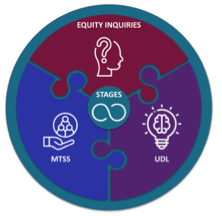
Increasing Equity in Education through Stage-based Implementation of Universal Design for Learning in a Multi-tiered System of Support
February 2023
This brief organizes equity inquiry, UDL, MTSS, and implementation science so that the frameworks can work together. The authors describe a coordinated Stage-based Implementation process with embedded, systems level critical Equity Inquiries at every stage that enables schools to establish Universal Design for Learning (UDL) principles and guidelines within a Multi-Tiered System of Support (MTSS).
Courchaine, T., Jones, L., McCart, A., Skelton, S.M., Ward, C. & Woods, K. (2022). Increasing equity in education through stage-based implementation of universal design for learning in a multi-tiered system of support. Great Lakes Equity Center, CAST, National Implementation Research Network, and SWIFT Education Center.
EdTech for All: Video Series
The U.S. Department of Education invites you to join the first educational technology (edtech) webinar to learn about WEGO-RIITE in this live online webinar.
- What: WEGO-RIITE is an online tool aimed to improve essay writing for writers with and without disabilities and to support teachers in data-driven decision-making during writing instruction.
- Who: Learn from the WEGO-RIITE developer, an educator who uses WEGO-RIITE with their students, and a parent whose child uses WEGO-RIITE.
- When: Thursday, March 30, 2023 @4-5pm Eastern Standard Time.
- How: You can compete this registration form to sign up to join the live webinar. If you cannot watch live, the recorded webinar will be posted on the Office of Educational Technology YouTube and Office of Special Education Programs IDEAsthatWork website.
- Accommodations: Auto-closed captioning and ASL interpreters will be available. Please email ED.Tech@ed.gov for any other accommodations or needs with subject: “Edtech for all video series”
Evaluators' Corner


CIPP Brief: Compared to What? Identifying Good Comparison Data to Assess Project Result
It is important to measure the outcomes of your project, but measuring outcomes in isolation does not tell the full story. You need to consider how the outcomes may have been different if the project had not been implemented. That is, you need to know, “compared to what?” Comparison data can dramatically strengthen your evaluation by helping you tease out the unique contribution of your project to its expected outcomes and by describing how your project has influenced outcomes for the intended recipients. Collecting comparison data can help to bolster your evaluation findings, even if the use of appropriate comparisons is limited to one of several intended outcomes or one aspect of a complex project or intervention.


Tweets, Podcasts, & Videos of the Month



SISEPcenter (@SISEP) Tweeted: We are excited to announce that the AI Hub will be moving! Check out the video below and visit the new site at https://t.co/16UpN4SGrR.
@ImpScience #ImpScience #ImpPractice
ED_Sped_Rehab (@OSERS) Tweeted: OSEP Director Williams addresses discipline inequities and exclusionary discipline in her ongoing Discipline Discussions series. @IDEAdataCenter & @TheNCSI share resources to support school and program leaders/educators to address discipline disparities.


 Built with Shorthand